Inside the SEO Pack: the six functionals

Specs, real screens, and an interactive demo for each one.

Inside the SEO Pack: the six functionals

Page-level SEO and GEO metadata

The title Google shows, the card people see when the page gets shared, and the data AI assistants read are all filled in on the same screen where the content is written. Everything else is generated for you.

Interactive demo

The full walkthrough on a live instance, from the empty tab to the generated head block.

The problem

On most sites, SEO lives far from the content. An editor writes the page; then someone else — a specialist, an agency, a developer — loads the title and description into another tool, or files a ticket for it.

  • New pages ship with no metadata and stay that way for weeks.
  • The Google title and the page title say different things, because they were written at different moments.
  • Nobody knows which pages are properly filled in, because there is no single place to look.
  • Changing fifteen words costs a development cycle.

And since 2024 there is a new problem on top of the old one: AI answers. ChatGPT, Claude, Perplexity, and Gemini no longer send traffic through ranking alone — they cite content they understand. If the page does not state clearly what it is about, they do not cite it.

What it solves

  • SEO gets filled in as you write, not afterward. The tab lives in the same form. The editor changes neither tool nor permission, and the page never ships «to be completed later».
  • No field is required and no empty field breaks anything. Everything has a fallback: no title falls back to the page title, no description falls back to the summary. Filling fields always helps and is never a precondition.
  • The mechanical parts are never typed. Canonical URL, social card, dates, crawler directives, structured data, and the publisher block all come from what the editor already wrote.
  • Built for AI search, not just Google. The summary, topics, and FAQ exist so an assistant can understand, place, and cite the page.
  • Multilingual by default. An untranslated language falls back to the default instead of going blank.
  • An escape hatch. If a case does not fit the fields, a raw JSON-LD field replaces the generated block.

How it works, step by step

The first pass takes ten minutes.

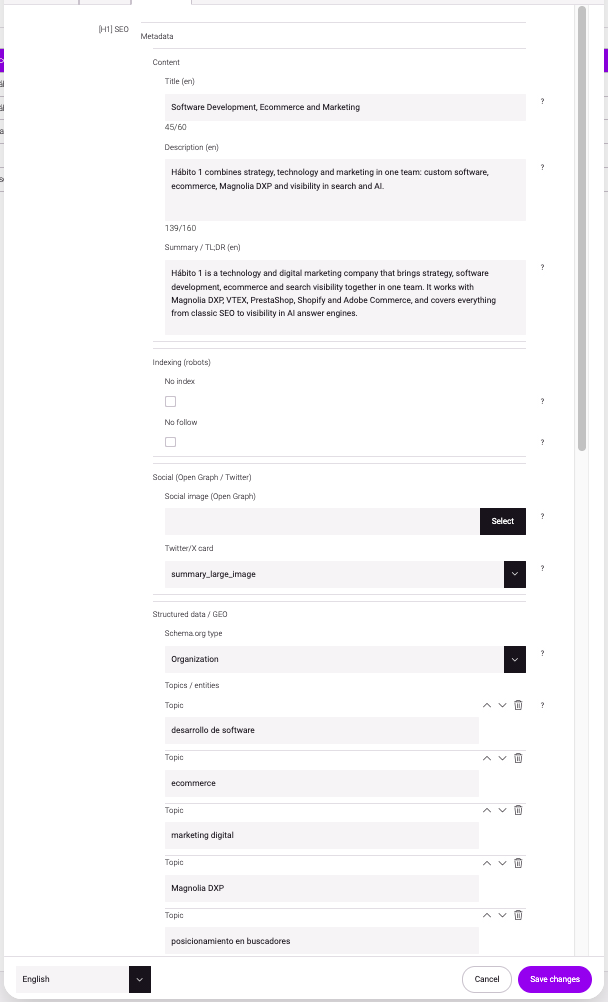
  1. Open the page properties and go to the [H1] SEO tab.

The tab lives inside the properties dialog, alongside the others.

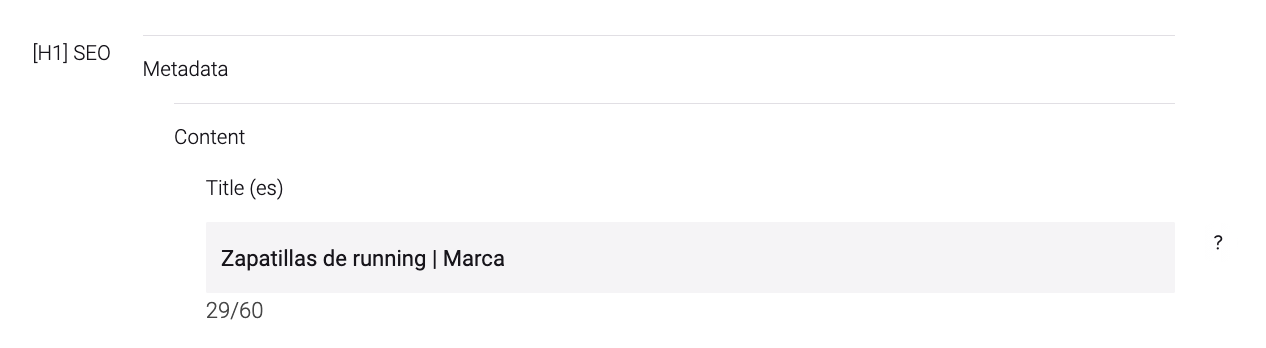
  1. Under Content, write the Title: 50 to 60 characters, keyword first and brand last. The field cuts off at 60 and shows a counter.

The live counter, so you do not exceed the length Google displays.

  1. Description: 140 to 160 characters with the value proposition and a call to action.
  2. Summary / TL;DR: one to three sentences in plain language. This is the highest-return field — it feeds AI search and llms.txt, and it is the description's fallback.
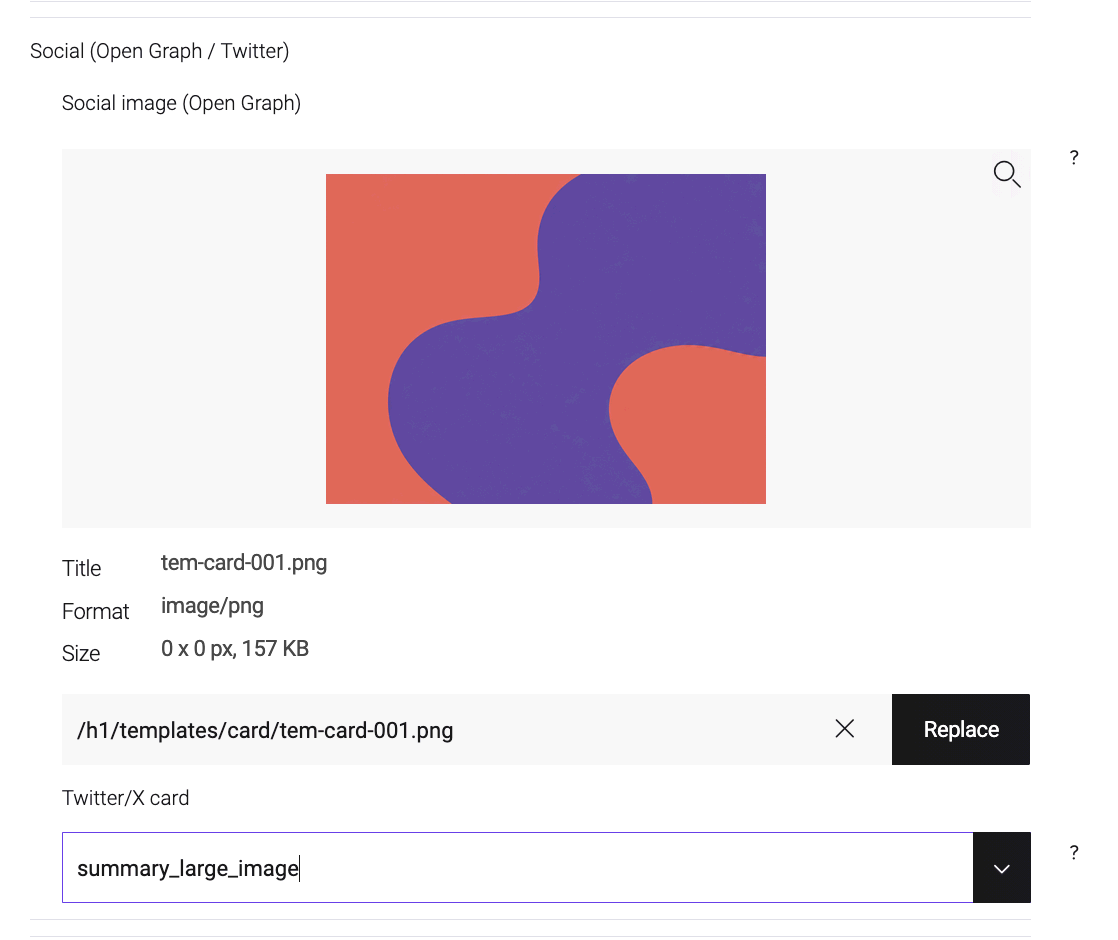
  1. Under Social, pick the image: 1200×630, under 1 MB, subject centered. Left empty, the site default is used.

The loaded thumbnail and the Twitter/X card selector.

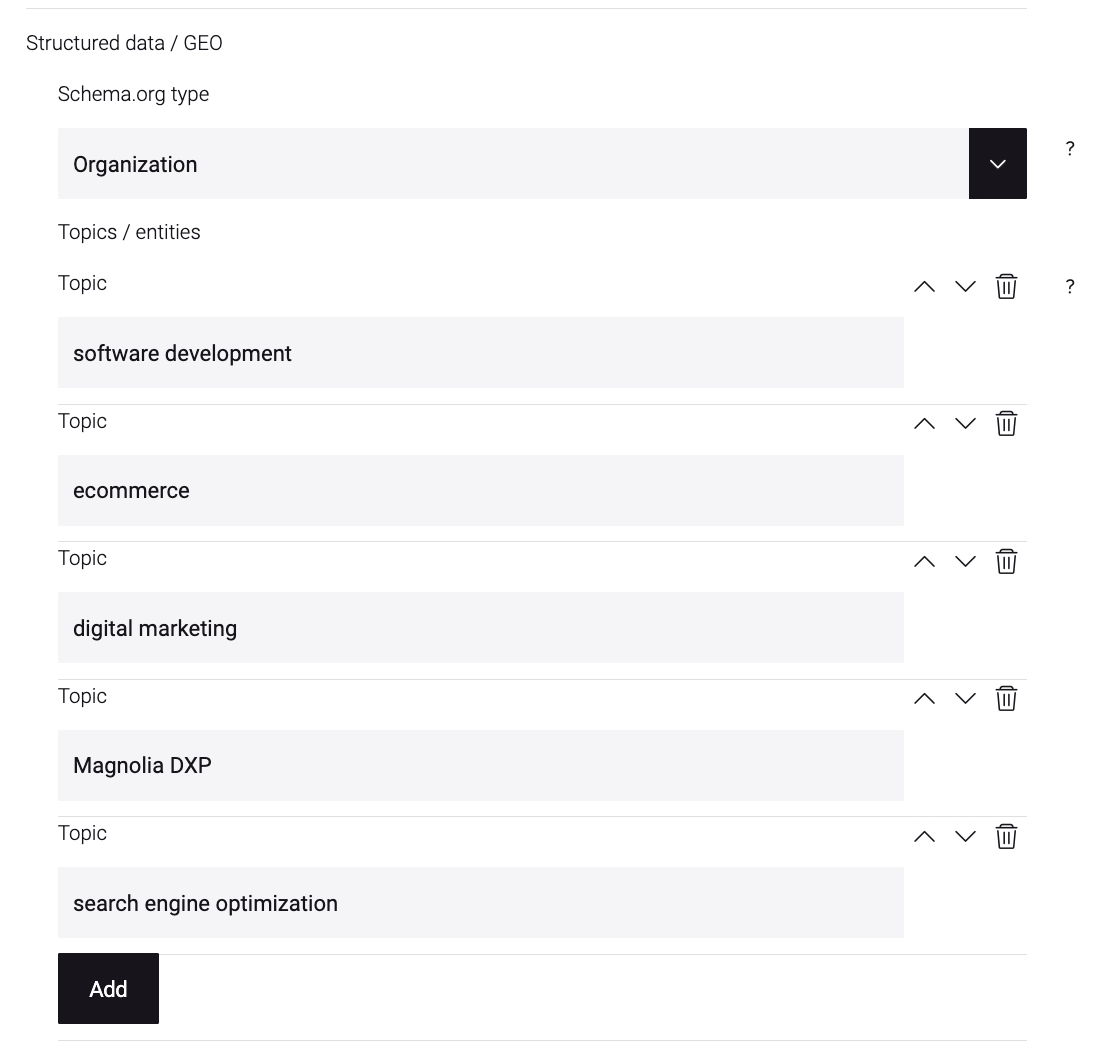
  1. Under Structured data / GEO, set the Schema.org type if the page is not a plain WebPage, and add three to six topics in plain language.

The chosen type and the topics, one per line.

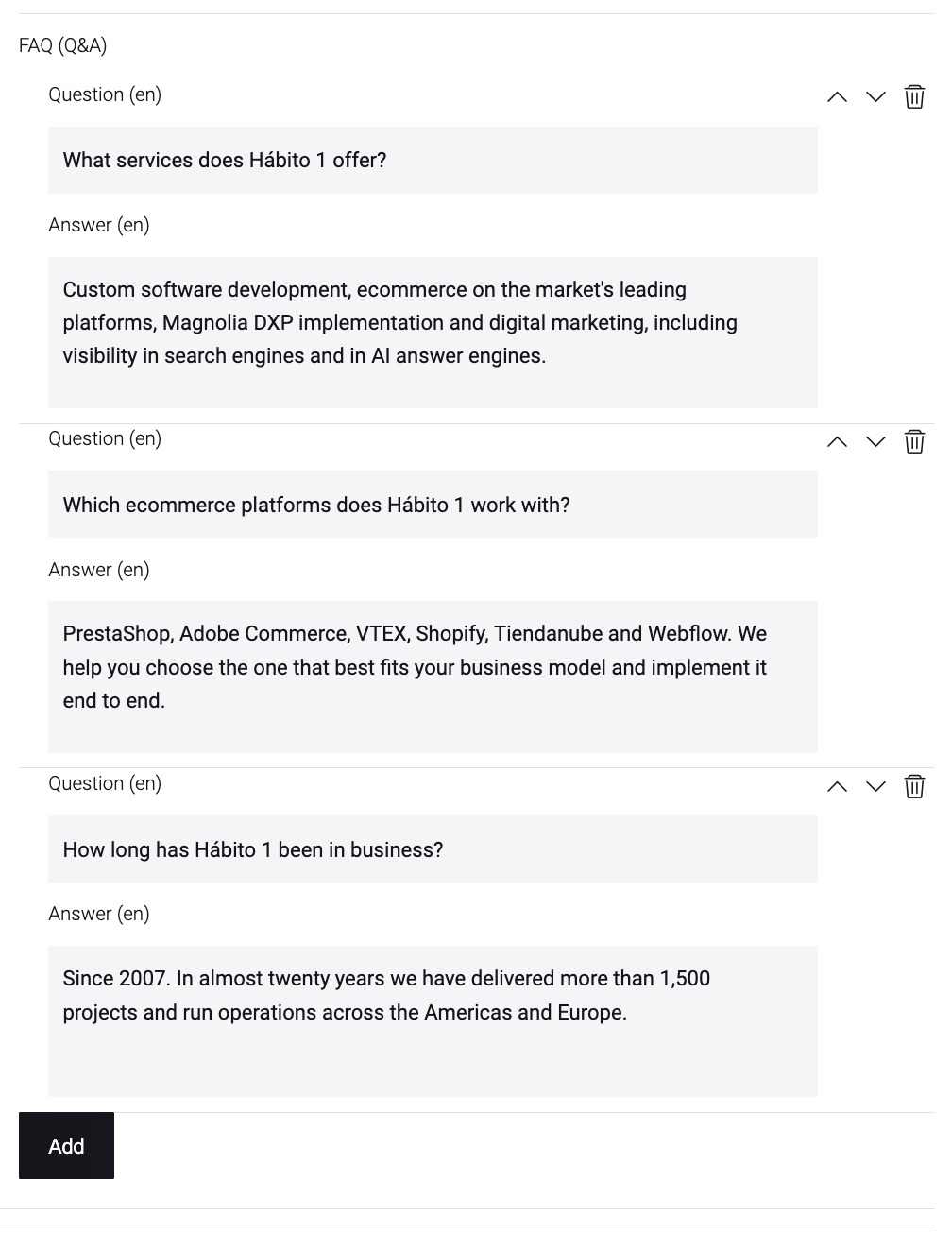
  1. FAQ, when the page answers real questions: pairs of one to three sentences. Google can show them as an expandable block and assistants quote them verbatim.

Two entries expanded, with the question and answer written out.

  1. Save. There is no separate metadata publishing step — it travels with the page.

The three switches that hide content

This is where people get confused most, and it is worth spelling out every time.

  • No index — removes the page from search results and from llms.txt. It does not take the pages below it.
  • No follow — hides nothing. It only asks crawlers not to follow that page's links.
  • Exclude from sitemap — removes the page from sitemap.xml, and it does take the whole branch.

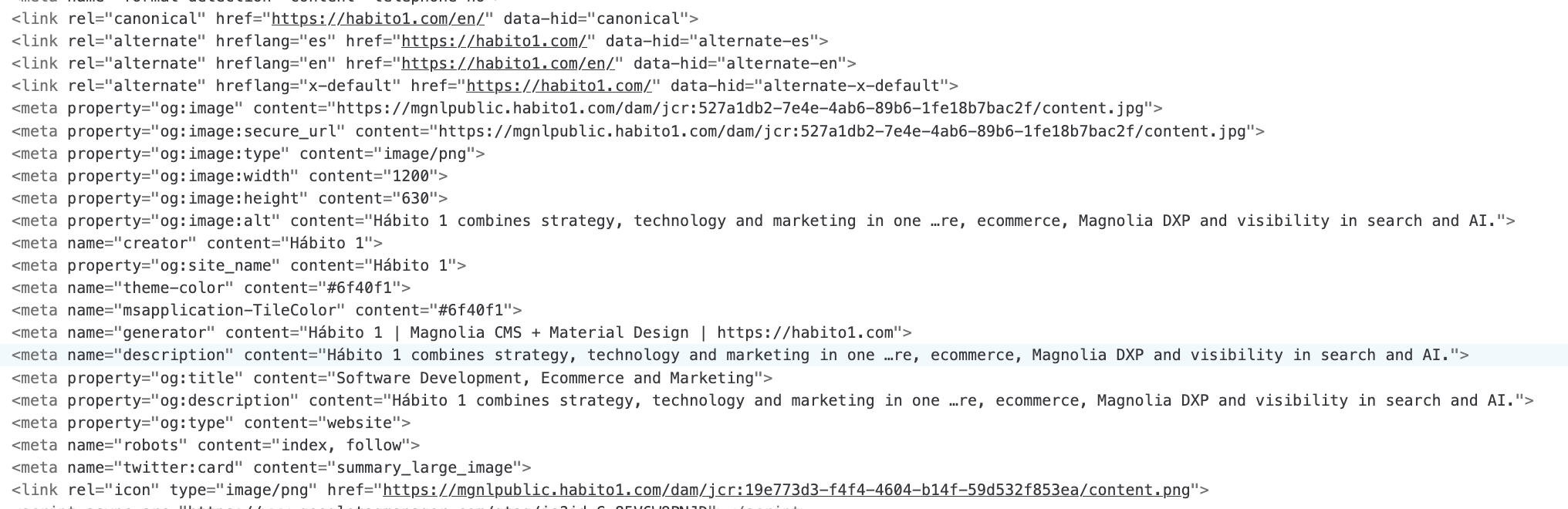
The published page's head block: canonical, Open Graph, Twitter, and the JSON-LD. None of it was typed by hand.

What it does not do

  • It does not audit. It will not tell you which pages have weak metadata or score a site's SEO.
  • It does not suggest keywords or analyze competitors.
  • It does not write the copy for you, unless you use AI Chat, which is a separate module.
  • It does not guarantee rankings. It gives you control and technical consistency; content and domain authority are still the work they always were.

Back to the product

This page is the module's functional spec. The product overview — what it includes, who it is for, and how to get it — lives in SEO Pack, and the rest of the platform's modules in Products.

Want to know more about our services?

Share your details and we'll get in touch.

arrow_drop_down
Thank you! We received your message and will reply soon.

Hábito 1 brings strategy, technology and marketing together in a single team to take companies' digital presence to the next level.

Do you accept our cookies and privacy policies?

Your privacy is important for us. Therefore, we inform you that we use our own and third-party cookies to perform analysis of the use and measurement of our website in order to personalize content, as well as provide functionalities to social networks or analyze our traffic. To continue accept or modify the configuration of our cookies.

Privacy Policy
Cookie settings
  • Necessary

    They make the site work and remember your choice. Always on.

  • Marketing

    They let us show you relevant ads and measure campaigns.

  • Analytics

    They help us understand how the site is used so we can improve it.